

Your time is precious, and you want to make the most of it. But it’s hard to keep up with all the tasks and responsibilities that come your way. You keep getting new things to do, and it’s easy to feel overwhelmed. You sacrifice time with your family for work, but it doesn’t seem to make a difference. You keep getting more work, and it’s like you’re stuck in a never-ending cycle. But there’s a way out of this. You just need to learn how to manage your time effectively.
Symptoms of Poor Time Management
Often, when dealing with a project in trouble, I see time management issues. This manifests as symptoms affecting work performance and needs to be addressed to improve project flow. These are most prevalent in managers, but I also see them in others when working on projects in trouble. In fact, the symptoms of poor time management are one of the major causes making a project feel like it’s a real dumpster fire. These symptoms usually manifest as one or more of the following.
The Feeling of Being Overwhelmed: This is the biggest, most common symptom people have, signaling time management problems. You feel overwhelmed by your to-do list, and no matter what you cross off, it never stops growing. The feeling wears on you eventually, leading to burnout. A manager friend of mine once started the week with 10 items on his to-do list…he ended the week crossing off 4 items and adding another 17. He worked nights and weekends on those only to start the cycle all over again. Why would anyone want to operate that way continually?
The Feeling of Doing Others’ Work While Neglecting Your Own: This phenomenon arises when you have your assigned tasks to complete, yet other individuals delegate their work to you. Despite the fact that the work is their responsibility, you may feel overwhelmed and burdened. However, at a subconscious level, you may harbor the belief that you are capable of performing the task better than them. Consequently, you may add their task to your list of responsibilities, leading to distractions from your primary obligations. It is crucial to remember that as a manager, it is essential to fulfill your own responsibilities. While you may not face immediate consequences for not completing someone else’s task, failing to fulfill your own responsibilities can certainly get you fired.
Procrastinating: You delay starting or finishing important tasks because you feel other assignments are of higher priority. No one told you priorities, and if they did, their stuff would be first on the list. So you put off other things you need to do for their work. This may manifest as a feeling, though not always, similar to the feeling like not enough time to get things done. Regardless, the true symptom is important tasks you need to complete are getting delayed. After all, who wants to do performance reviews when you have four hours of meetings to attend?
The Feeling of Needing to Accept Assignments: We take on assignments because it’s what we’re expected to do. We want to show that we’re part of the team, part of the club, and someone that the higher-ups can recognize and trust. We want the raise or the promotion. Our pride gets in the way, and we accept more work. After all, when a superior approaches you and requests tasks, and he carries an invisible sign on his head that proclaims, “I am the Boss. I have the authority to grant raises and promotions, and I have the power to fire you,” how can you say no to that?
Impact of Poor Time Management
You have bad time management. So what? Why should you care? Or more importantly, why should your boss, you know the guy with the big invisible sign, care? You and the team, including your supervisor, should acknowledge that poor time management leads to other management challenges that negatively impact a team’s performance and project success. This can result in broader issues that adversely affect the outcome of company goals, causing delays, employee turnover, increased costs and reduced deliverable quality.
Burnout: When attempting to accomplish everything, you may experience a sense of overwhelm. This can lead to excessive work hours and burnout. In turn, this can negatively impact your sleep quality, affecting your physical and mental well-being. Your relentless pursuit of perfection may also diminish your enjoyment of personal time outside of the office, further compromising your overall well-being. Prolonged such behavior can result in a loss of interest in the project, the team, and your objectives. My manager friend mentioned above left the company to solve his burnout, but this created new problems that needed attention.
Things Fall Through Cracks: When you neglect effective time management, you inevitably allow tasks to slip through the cracks or completely neglect them. While this approach may seem healthy, the problem arises when you prioritize the wrong tasks. Consequently, crucial tasks are overlooked, leading to project issues. I’ve witnessed many projects get in trouble in their final days due to forgotten requirements, leading to increased costs, delays, and a scramble to resolve the issues.
Relationships Suffer: When you fail to manage your time effectively, your relationships suffer. First, your personal relationships are affected. You don’t meet commitments or expectations set by your loved ones, which can drive a wedge between you and those you care about. Neglecting family for work all the time only exacerbates this problem. Second, your work relationships suffer. When you can’t manage your time effectively, your colleagues perceive you as unreliable or constantly stressed. Having a calendar full of meetings doesn’t make you an effective manager. It sends the message that you don’t have time for your employees or for your own responsibilities.
Morale Degrades: As mentioned earlier, poor time management is one of the main reasons a project is perceived as a dumpster fire. When you, as a manager, can’t manage time effectively, this passes to the employees who are most likely not as effective at managing their time than you. They do what they are told and, after all, you are the boss and you can fire them. If you can’t manage your time, you can’t help them manage their time. They then see the results of the burnout, things falling through the cracks, the breakdown in relationships. All that tears at morale, resulting in mediocre outcomes for the project, high turnover, and delays in getting things finished which leads to added costs and added stress further perpetuating the cycle of chaos.
So why should you, or your boss, care about time management? Poor time management is expensive. Every hour you spend on frivolous assignments or unimportant tasks is an hour you aren’t spending providing value to the project and the organization. If you are spending 25% of your time on non-value-added work with a shop rate of $150 an hour, over the course of a 2,000-hour year, that’s $75,000 spent on activities that are likely unneeded. That also doesn’t consider the cost of turnover, or the cost of schedule delays, or the propagation of poor time management down the organizational structure. How can you not afford to practice some level of responsible time management?
Organize the To-Do List
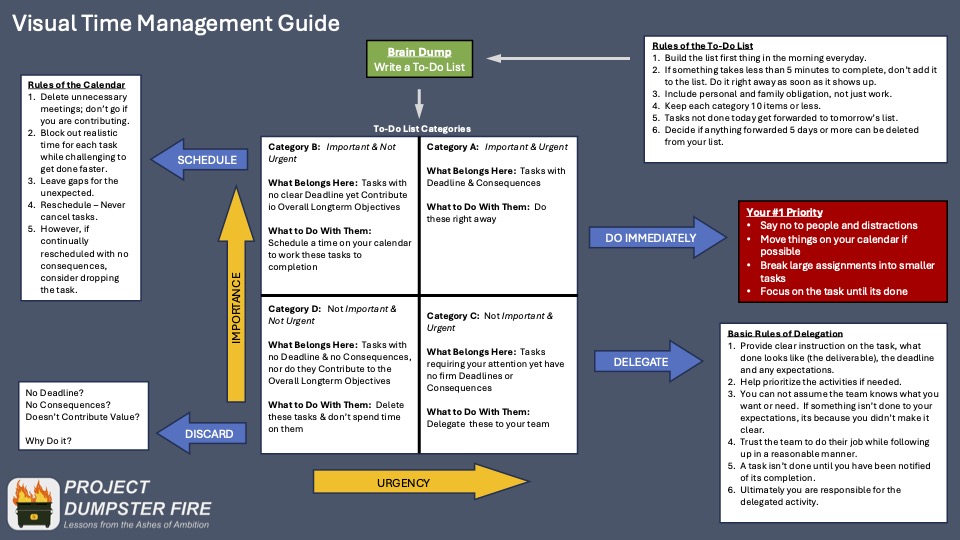
To take control of your time, first understand your tasks and prioritize them. Delegate what can be done and schedule what needs to be done. I recommend using the Eisenhower Matrix as a tool for this. This method involves creating a list of tasks and categorizing them. Start by brainstorming and writing down everything you need to do, regardless of its importance. Include small tasks, assigned tasks, and kid’s activities. Once that’s done, you can sort and prioritize the list.

The Eisenhower Matrix, inspired by the late President and General Eisenhower, creates four categories of tasks to be done: Important & Urgent, Important & Not Urgent, Not Important & Urgent, and Not Important & Not Urgent. For this list, I recommend grouping these categories as A, B, C, and D, respectively. So, for each and every item on your list, mark it as to where it belongs. Then, for each category, assign a priority of 1, 2, 3, and so on until every item is given a letter and a number.
You might now ask how do you categorize things? After all, what is important to one person isn’t necessarily important to another, and the same can be said of urgent tasks. So how do you know how to place what task where? The answer is it’s your call. However, I recommend using the following as a guide:
- Important & Urgent (A): These are the tasks for which there are deadlines, and not meeting the deadlines has a consequence. Failing to submit a proposal on time or not signing a time card at the end of the week are examples. Missing the proposal deadline might mean not getting the work, and not signing a time card means your employees might be delayed in getting paid. Both of which are unpleasant things to have to deal with and explain to the boss. If there are no consequences or there is no due date, it’s not part of this category.
- Important & Not Urgent (B): These tasks, which lack specific deadlines, contribute to the overall long-term objectives. Examples include reviewing reports, setting project or employee goals, and contacting contractors to obtain bids for house painting. While these tasks may not have clear due dates, their completion is essential for achieving the desired outcomes of the project.
- Not Important & Urgent (C): These tasks demand your attention, but they do not have deadlines or severe repercussions. Examples include providing technical information for a status presentation or responding to an inquiry. The key is that you need to be involved in the task, but it does not require your undivided attention.
- Not Important & Not Urgent (D): These tasks lack deadlines, consequences, and do not contribute to overall objectives. They are time-consuming and do not benefit the team, company, or personal life. Examples include unnecessary meetings, excessive note-taking, and working on tasks not assigned to you. These activities can be removed from your to-do list without significant impact on your life.
Once you’ve categorized the items, how do you prioritize the list? Remember, it’s your call, and you should be able to go through the list and rank the items in order of priority. Typically, the most important and urgent items should be at the top, while the least important ones should be at the bottom.
So, you’ve compiled the list. Now, it’s time to simplify and organize your life.
- For the Important & Urgent Items (A): Do those items immediately. These are of such high priority that they demand your immediate and undivided attention. Get them done. You don’t want to remain in this state for too long, as it will only consume your time.
- For the Important & Not Urgent Items (B): • Schedule a time to do these tasks. Use your calendar as a time management tool to make meetings or personal appointments, block out the time, and complete the task. Avoid any interruptions during the appointment.
- For the Not Important & Urgent Items (C): Delegate these tasks. While you need to be involved, let someone else take responsibility for completing them. As a manager, utilize your team to accomplish this.
- For the Not Important & Not Urgent Items (D): Remove these items from the list. If they serve no purpose, do not contribute to the organization’s or team’s success, and do not impact your personal life, it is not worth expending energy on and should be discarded.
Here are some rules for the to-do list:
- First thing in the morning, daily, and even on weekends and holidays, list and organize your tasks. It’s crucial to organize your life, and developing and maintaining this habit is worth it.
- Family comes first. Of course, when you’re at work, you need to focus and complete your work assignments. You also need to plan and make time for your family. If there’s something important going on in your personal life that needs to be done, it goes on your list, gets scheduled, and gets done. Don’t put off doctor appointments or miss your child’s activities just for work. Work will always be there. Prioritize your personal life.
- Keep your categories to a maximum of ten items each. If you exceed this limit, it can become overwhelming, making you feel like you haven’t accomplished anything. If possible, reorganize your items into other categories, discard them, or discuss the issue with your boss. If they are understanding and competent, they can help you by reassigning tasks or prioritizing them.
- Tasks that aren’t completed today are forwarded to tomorrow. They appear on tomorrow’s list, sorted alongside any new tasks, and you work on them.
- Evaluate anything forwarded more than 5 times to decide if it really needs to be done. If it’s not important enough to get done right away, it’s probably not important to begin with. If no one is after you on status about the item, there probably isn’t any urgency in it. Look at it and decide if it can be deleted.
- Anything that takes less than five minutes should be completed immediately. Don’t even add it to your list if it arises unexpectedly during the day. This contradicts the previous advice. You shouldn’t let such short-duration tasks occupy your time and contribute to your stress. I’m surprised how many people include small, trivial tasks on their to-do lists and then agonize over them, allowing themselves to feel stressed. Responding to calls or emails, having difficult conversations, updating status slides, and countless other small tasks fill up to-do lists for no apparent reason. Simply get those small tasks done immediately and out of the way.
Your Calendar
The calendar is one of the most underutilized professional tools on their computer. As employees, we often let others populate it with meetings and other commitments because we believe we don’t have control over our own calendars and that’s what we’re expected to do. To those bosses who believe they own their employees’ calendars, I encourage them to help utilize it more effectively. It’s an efficient tool for organizing and planning a day.

The calendar, when used effectively, helps you set aside time for you to do what you need to do. You don’t have to, nor should you ever, plan out every hour of the day. Use it to block out time for those items you need to schedule to accomplish. Set aside time first thing in the morning to plan out the day and go through email. Limit it to 30 minutes, set it recurring, and just do it. Then at the same time every day, you have a fixed block of time to do that task. And if you don’t limit your engagement with email, well, you need to, as it’s a real time killer. That’s a topic for another day.
During planning time, allocate time slots for Category B tasks, important but not urgent ones. Set realistic durations. Break large tasks into smaller blocks to fit your day. Just set a time to work on them so they’re done predictably.
Things happen during the day. Meetings pop up, and crises occur, disrupting your day. That’s part of work and life. These scheduled tasks don’t get canceled unless you delete them from your to-do list. So, when a crucial meeting supersedes your planned day, you don’t cancel the self-made appointment to complete the task that gets bumped. Instead, you reschedule it by moving the chunk of time to another spot on your calendar.
That’s it! There’s no magic secret. Simply let the calendar organize your day. Once you set up time slots, you work the schedule, ensuring you keep your appointments with yourself. This approach relieves the stress of managing a to-do list. It clearly shows when you plan to work on what and when. It also helps you estimate the completion time for those tasks.
Here are some rules of the calendar:
- Reschedule instead of canceling. If an appointment is important enough to get done, don’t cancel it when another task arises. Move things around to ensure you have time for the task.
- Challenge yourself on the duration. Work expands to fill the allotted time. If you give yourself three hours, it will take the full three. But if you cut the time to an hour, you only have an hour to complete the assignment and avoid non-value-added activities that affect productivity. Be realistic but challenge yourself to finish sooner than expected.
- Leave gaps in your schedule to accommodate unexpected tasks and give yourself breathing room.
- Things that keep getting rescheduled should be dropped or delegated. Treat your calendar as a commitment. Once scheduled, do the task at the allotted time. If it’s not important enough to get done when you said you would, ask if it needs to be done or if you should delegate it.
- Remove unnecessary meetings and appointments from your calendar. If you’re not part of a meeting and don’t actively participate, ask if you need it on your calendar.
Getting Your Time Back
Once you get your to-do list sorted and things scheduled, you’ll find you have more time and feel less stressed about the day. Saying no to unimportant and non-urgent tasks clears out a lot of clutter. Making a plan to tackle those jobs that linger will help clear your plate. Show others you value your time and they will learn to respect it too.




 Project: Dumpster Fire
Leave a comment